Reading time: ~9 min
TL;DR
Hi! This is my first post. I'm Antonio, from Spain. I ramble a bit here, then I introduce myself, my research, and my journey: how I went from physics to medical AI startup to space science research. Then, I tell you about my current side project as indie hacker. Lastly, I mention what I want this blog to be about: AI research and tutorials, documenting my journey as I build my side project, and just any other stuff from my life.
Introduction
This is my first blog post, so I want to introduce myself a bit. Also, a disclaimer: This post will be long, since I'll try to summarize my life up until now, my background, and current projects. Perhaps unnecessarily long, but that's the point of a blog, right? A personal place where I can express myself as I am.
Anyways, I've always, or for a long time at least, wanted to write a blog with a collection of my thoughts, experiences, research, or any other random stuff I like. I've been at this for years: when an interesting thought strikes me or I find some cool fact, piece of knowledge, research paper, anecdote, side project, etc. I wanted to write it down, but I never did. In a sense, I feel like I've lost time and opportunities to write and tell the things I do, so enough is enough! From now on, I'll write as much as I can here about anything that I consider worth telling... or just anything. I make no promises, but I'll try to be consistent.
About me
I'm Antonio, and I'm from Spain. I'm a researcher at the University of Alcalá as of October 2025. My research focuses on using computer vision techniques to detect and study solar filaments, a type of phenomenon occurring on the Sun's surface that is linked with eruptive phenomena, such as coronal mass ejections (known as CMEs) or flares. If you like science, especially space science, I'm sure you have probably seen some of those outstanding high-resolution images of the Sun ejecting what seems like "tongues of fire" (the filaments). If not, here you can see a video from Wikipedia of an erupting filament:
These eruptions often shoot those enormous CMEs into space, which are, broadly speaking, magnetic clouds the size of several Earths, traveling through space at high speeds. If one of those big CMEs had arrived on Earth a few hundred years ago, it would probably have caused... nothing. Well, nothing really dangerous, apart from beautiful auroras, since the Earth has a magnetic field that shields and protects us from these harms. Otherwise, we would have been fried long ago. In fact, life on Earth would not be possible, or at least, not as we know it. But if a strong CME were to arrive on Earth today... That's a different story.
We rely on many digital technologies nowadays, and all of them are susceptible to being disrupted by these solar storms, which would cause serious problems to our society (there are crazy stories that already happened because of this, like the detonation of bombs in Vietnam, but that's a story for another post) and thus, it's important to keep track of them and study their origins. So that's what I'm doing, using AI to detect these filaments on images from the Sun to analyze them and, hopefully, find some way to predict or anticipate these eruptions or, at least, gather useful information.
I recently started my PhD on these topics, although it's unusual for people at my age to start a PhD. I'm in my 30s. So... what was I doing before? I was previously working at a medical startup called Medicsen. They’re developing a drug delivery device, which can administer drugs through the skin... without needles involved! It’s a very cool project that you should check out if technology interests you.
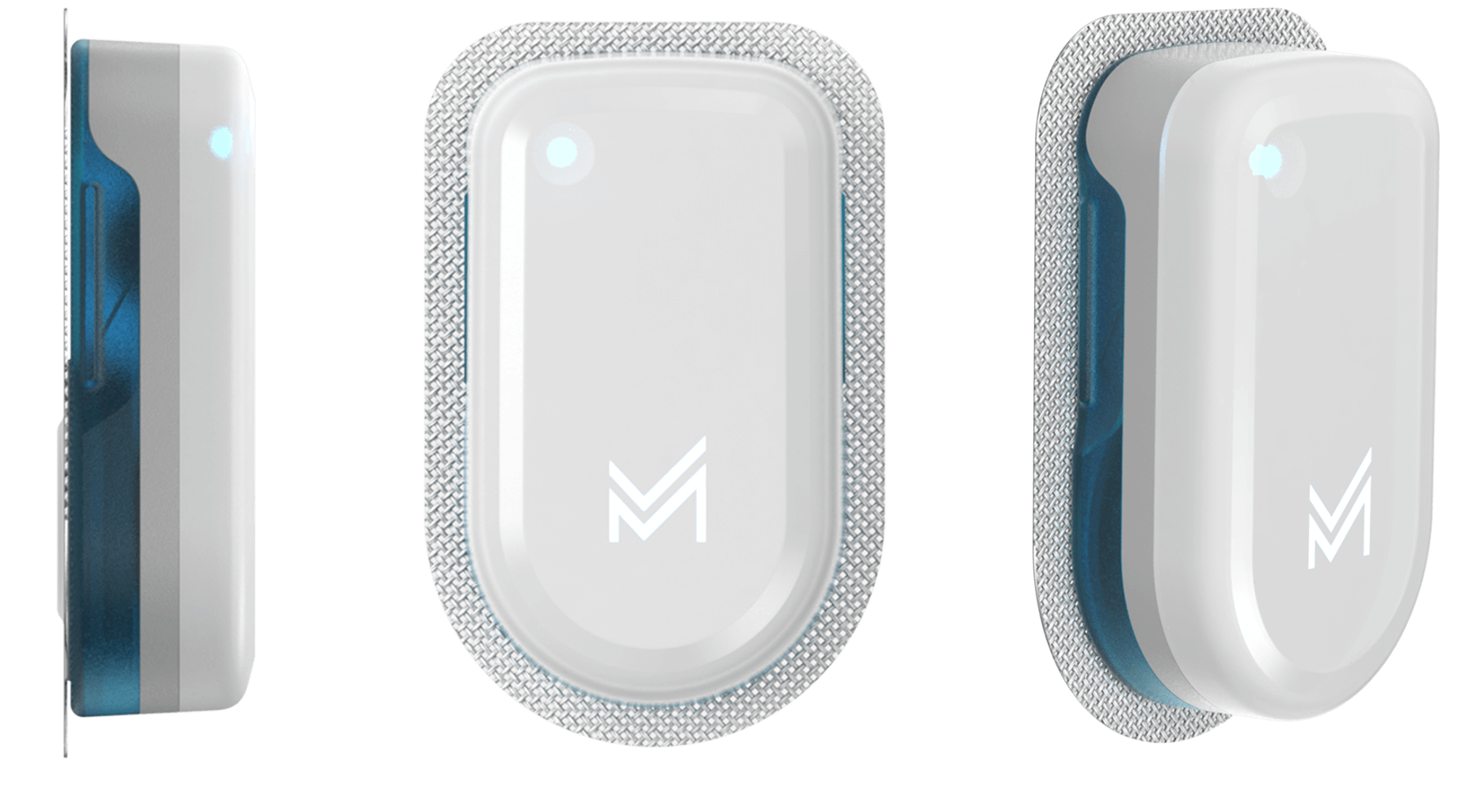
Medicsen's needless device
We were also working on AI-based solutions for chronic diseases, especially diabetes, where I was working on developing a glucose predictor for type-1 diabetes patients, among many other things. The idea is to eventually merge everything into an artificial pancreas: the needle-free device with an AI-powered algorithm that predicts your glucose levels and determines how much insulin you need to administer, based on your daily habits of food, physical activity, etc.
It's cool tech, and complex too. Also, it's a rough field for technology development, since there is A LOT of regulation in place to ensure safety. Nonetheless, I managed to develop an AI-powered glucose prediction tool that got officially approved and certified as a medical device by the Spanish Agency of Medicines and Medical Devices (AEMPS), and was used by real patients!! The final system was also completely self-autonomous, meaning that it was able to learn and retrain itself with more data, adapting to each patient differently. All of that by myself, self-learning everything about neural networks, servers, API calls, etc. I'm very proud of that :), as you may have guessed. I also did so many other things at Medicsen, but I don't want to extend this post too much.
So, this is cool, but how did I end up at Medicsen, doing medical AI research? Before Medicsen, I studied a BSc. in Physics, and then an MSc. in Physics and Mathematics, both of them at the University of Granada. Granada is one of the best and most beautiful places on Earth to live :)
During my BSc. I did one year abroad in Italy, and that's where I first discovered neural networks, by pure random chance: I wanted to pick some alternative courses in many different topics, so I picked many of them, and one of those courses was called Reti Neurali (Neural Networks). Most of the course was not really about neural networks as we know them today in the deep-learning sense; it was more about mathematical models that simulated neurons, and a tiny bit about machine learning and modern deep learning.
I was instantly charmed by neural networks and their potential, so I started studying them on my own. I still remember myself back there, imagining and barely grasping the implications and potential of this technology. That was around 2013-2014, when deep learning was still emerging, just after AlexNet's breakthrough, though I didn't know anything about that. I even built my first neural network as the final project for the course, from scratch, using C++ and Allegro. It was a very simple digit recognition tool: you drew a few 1s, 2s, etc. with your mouse, and then, after a few seconds, the network trained and learned them, then you drew new ones, and it told you which digit it was. At that time, for me, it was super awesome that a machine could do that, and that I managed to program something so incredible and complex just by reading a single book (Introduction to the theory of neural computation, by Hertz, J. et a.), but the teacher didn't look impressed (I don't know if he was, but to me it seemed that he was not). I can see now why; it was a very trivial thing.
So, long story short: from then on, I started studying neural networks and became even more interested in programming, complex systems, AI, etc. I enrolled myself in several related side projects, and one of them led one of my teachers to talk about me to a colleague with whom I ended up joining forces to search for ideas within the healthcare sector, which, in turn, led me to discover Medicsen. I then sent my CV, and the rest you know already.
As you can see, I've always loved self-learning and programming, and I continue to do so. For example, during high school, I made a few short video games using RPG Maker, and at some point, at the end of my first MSc. I started the development of a video game called Necrocosmos with some friends. I've participated in Kaggle competitions (though just occasionally and with no results), or right now I'm learning web development for my side project. I developed this entire website and blog from scratch. Well, using AI to guide and help me, but always learning the whys and hows. I also like to tinker with hardware. For instance, a few years ago, I repurposed my old university laptop and transformed it into a wooden computer, which is now serving me as a self-made server.
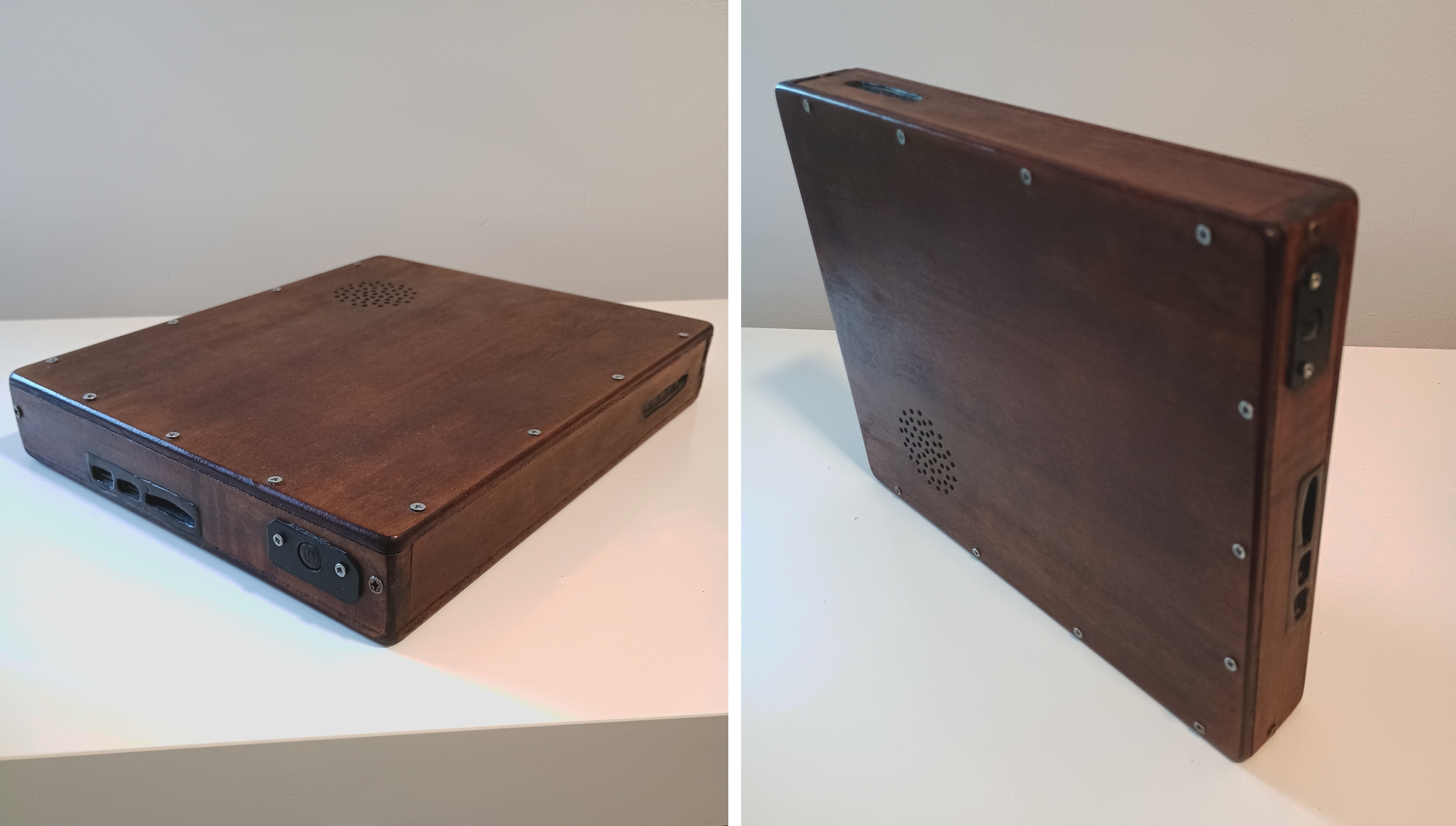
This is my wooden computer server
Perhaps this is a flaw in me; I always want to do everything from scratch and learn the inner workings of things, which considerably delays me on many occasions. However, I'm trying more and more to instead pick an already established solution.
My side project
And lastly, all of this leads to today. I'm still a researcher, and will continue to be one, but I also want to build something on my own, the indie hacker way. I've always wanted to create my own technology start-up, or at least to "apply the knowledge" I've learnt in science to solve real problems. That's one of the main reasons I joined Medicsen in the first place. But over the years, I've let this dream of mine fade away and ignored it when I shouldn't have. Not anymore. So I started looking for ideas.
Some time ago, while talking with my partner, she was complaining about the difficulties of adapting your paper for publication. For those of you who are not familiar with the research publication process, when you finish any research, you normally write it down in the form of a manuscript that you then publish in some journal as a paper, so anyone can read and reproduce your work. It has more nuances than that, but that's how research publication works. So, the first thing that you should do before publication, apart from writing your research manuscript, is to choose a journal, and once that is done, you have to search for the journal's guidelines, since each one has its own formatting requirements, and there is not a single universal standard. Then, you must carefully read those rules and apply them to your manuscript. For example, language style, maximum word count, naming conventions, keywords, etc. This is usually a very time-consuming task that doesn't contribute in any meaningful way to your research work; on the contrary, it steals away your precious time.
My partner was complaining because her work had been rejected by several journals, and each time she had to completely reformat her manuscript. Some journals required writing a small post for Twitter or other weird, nonsensical requirements. All of these reformats took several months out of her time, so she asked me, "Since you're looking for ideas, why don't you try to automate this? I'll certainly pay for it, or at least find it very useful." And that's what I did.
I called the project Paper Pivot . My idea with this is to build a universal translator: you write once your manuscript, in the format and with the tools that you like the most, and then give it to Paper Pivot, telling it in which journal you want to publish. The rest will be handled by the tool. The core idea is dead simple, except it is not.
During the past year, on my weekends and some evenings, I started prototyping the idea. At first glance, with the current state of LLMs and AI in general, it seemed very simple and easy: just give your manuscript and the guidelines to an LLM and ask it to reformat for you... But this didn't work. It failed a lot and it's way more complex than I thought: you need to correctly scrape journal websites to find the guidelines, which in many cases are buried under multiple sub-links, then correctly interpret them, without missing any important rule or document, and then correctly check and apply all the rules, one-by-one, to the given manuscript, which the AI should have perfectly comprehended beforehand. All of that while loading and handling different document formats: docx, latex, markdown... This is no simple task and requires the conjunction of many different technologies, processes, and prompting techniques.
At first, I wasn't very serious with it, but I tried to be consistent, so it took me a very long time to develop. I failed many times, and it's not perfect yet, but I've come up with a prototype that most of the time works! One year in the making, but I did it!
Once the prototype was done and tested (this was around August 2025), I started building a user interface around it, a web application, because right now you can use it only in a Linux terminal, by running several Python scripts. Web development, eh? Sounds boring, but easy... Oh. My. God. This is a monster: user interfaces, databases, servers, hosting, domains, email, subscriptions, HTML, CSS, JavaScript... It has been a nightmare, but I've managed to learn most of the things I need, and I hope to finish the MVP (minimum viable product) in the upcoming months. I could also go faster thanks to my previous experience with servers, cloud computing, databases, and API calls from my time at Medicsen, though it wasn't nearly as complete as I wished.
In August, I launched the project's website to start announcing it and to try to gather some interest. You can check it at paperpivot.com.
And this is what I spend most of my weekends and afternoons doing nowadays, and now this blog too, apparently.
About the blog
So... after all this long post about me, what do I want this blog to be about? I'd like it to be a bit of everything. I'd like to write some very detailed tutorials about neural networks and their applications in a "zero-to-hero" style, so anyone can learn. I also want to analyze in detail some research papers, concepts, and code, but I also want to document my journey as I build Paper Pivot, to tell anecdotes, other projects I might do, my thoughts, or anything else. I don't know how much of this I will accomplish, or if any at all (I make no promises), but I'm committed to trying.
Thank you very much for your time :)